
Made in Vienna 🇦🇹
Follow us

Copyright © 2025-2026 Tretina.co

The short answer is yes, but the reason might surprise you.
May 25, 2026 by Alexey Tretina
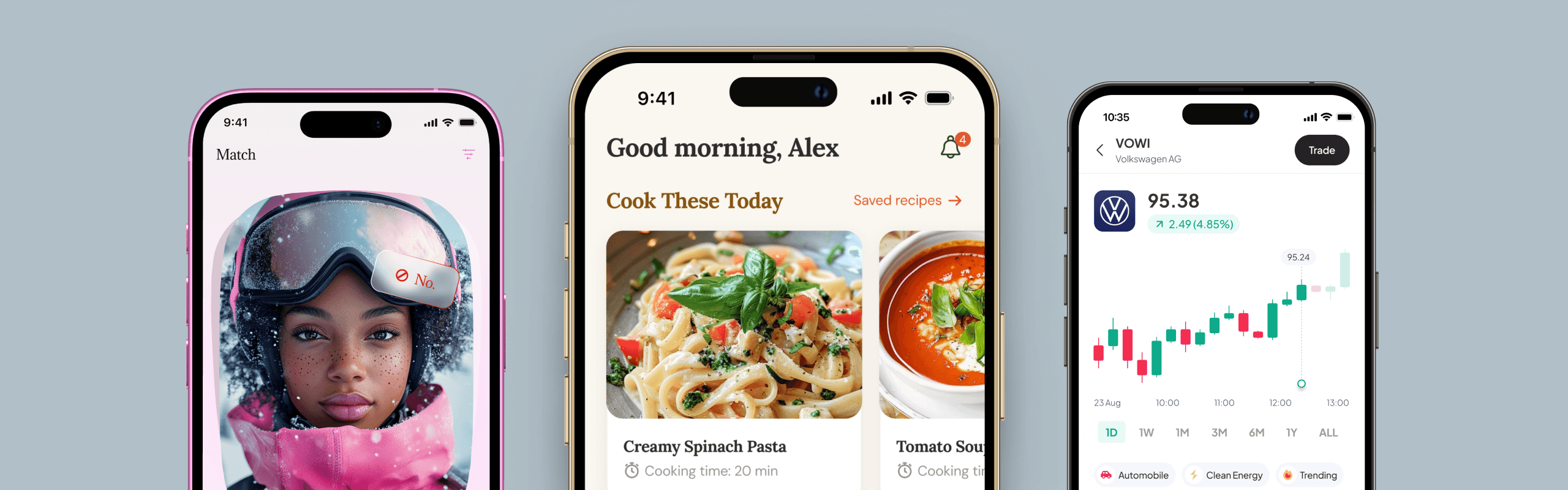
Ask any early-stage founder about their priorities and you'll hear the same familiar list: product-market fit, fundraising, hiring, growth. Design, if it comes up at all, tends to land somewhere near the bottom. It's a nice-to-have, something to polish once you've got traction.
In 2026, that instinct feels more justifiable than ever. With AI tools generating logos in seconds, producing polished UI screens on demand, and spinning up entire brand identities from a one-line prompt, the barrier to "looking professional" has essentially collapsed. Why invest in a designer when a $20/month tool can hand you something decent in minutes?
That decent is exactly the problem.
Let's be honest about what AI design tools do well. They're fast and cheap. They can produce work that looks clean, modern, and technically competent. For a scrappy team trying to ship a landing page before a demo day, that's genuinely useful.
But watch what happens when you ask an AI to make a design decision that actually matters?
Ask it to choose between two navigation structures and it'll give you the statistically safer one, the one that most apps use because most apps have always used it. Ask it to write a brand story and it'll produce something grammatically perfect and emotionally hollow. Ask it to design an onboarding flow for a product solving a specific human problem and it'll give you something that works, technically, while missing the entire point of why that problem hurts.
AI tools are trained on what already exists. They optimise for patterns. They compress toward the average. That's their superpower for speed and their fundamental limitation for meaning.
Design, at its core, is not about aesthetics. It's about understanding people: what they feel, what they fear, what they need but can't articulate. The best design decisions come from someone sitting in a room (or a Zoom call) with a user who is confused, or frustrated, or quietly delighted, and asking why.
No prompt captures that. No training dataset encodes the specific anxiety your users feel before they click "submit" on a form that handles their financial data, or the particular relief a parent feels when your app finally makes a confusing process clear. Those are human truths, and they require human curiosity to surface.
Early startups live and die by their ability to understand a narrow slice of people. That's the whole game. And design is one of the most powerful tools for translating that understanding into something a user actually experiences. When it's handed off to a system that has never spoken to your user, never felt their frustration, and doesn't know what your company actually stands for, then you lose that translation layer entirely.
There's another dimension to this that gets talked about even less: brand.
A brand is not a logo, a colour palette, or a design system. It's a whole point of view. It's the thing that makes your company feel like it was made by someone who actually cares about something specific. It's the visual and verbal expression of a belief, the vision and mission so to say. Brand is something about your users/clients, your industry, and your place in it. You cannot prompt your way to that.
An AI tool doesn't know why you started this company. It doesn't know the insight that keeps you up at night. It doesn't feel the tension between where your industry is now and where it needs to go. It can give you something that looks like a brand... and it looks like the brand of every other startup in your category. That sameness is the real threat. When everyone uses the same tools, they start to look the same. When you look the same, you compete on features and price. When you compete on features and price, you're already losing.
Scroll through Product Hunt on any given day. Open a dozen startup websites. You'll see the same gradients, the same rounded cards, the same hero section structure, the same sans-serif stacks, the same "Free Trial" button in the top-right corner. The aesthetic differences between them are almost non-existent.
This is what happens when design is optimised for adequacy rather than distinction. AI tools, trained on the internet's existing visual language, reproduce that visual language fluently. They are, by definition, backward-looking – excellent at recombining what's been done, unable to invent what hasn't. For a startup trying to carve out a position in a crowded market, looking like everyone else isn't neutral. It's a signal to users, investors, and potential hires that there's no strong point of view here, no reason to choose this over the next option.
The companies that stand out don't look slightly better than average. They look different in a way that makes sense, and that only happens when someone made a deliberate, considered, human choice about what this brand should feel like and why.
None of the above means AI tools have no place in a startup's design workflow. They're excellent for rapid prototyping, for exploring visual directions quickly, for producing assets at scale once the foundational decisions have been made by a human who understood the brief at a deeper level. But those foundational decisions that define how your product feels, what your brand says about your values, how your interface guides a user through a moment of uncertainty – all of those require something AI simply doesn't have: empathy, informed judgment, and the willingness to make a bold choice and defend it.
A great designer brings your users' perspective into the room. They push back when a business requirement will frustrate the person using the product. They spot the gap between what a founder thinks users want and what users actually do want. That's not a workflow, it's a skill.
In a world where the visual floor has been raised by AI, the ceiling (the work that actually moves people) has become even more valuable.
More than ever.
Not because it always has, and not despite the rise of AI, but because of it. When generating an okay design costs nothing and takes minutes, the companies that invest in design that is genuinely intentional, human, and built on real understanding of their users will stand out more, not less. The AI can give you a face (the one you have after visiting a dentist), but it takes a human to give your company a soul. That's why design is very important for early-stage startups.
Tretina.co is a design agency that helps early-stage startups build brands and products with clarity, character, and craft. If you're at the stage where "good enough" isn't good enough, let's talk.